
US stocks soar and recover more than half of last week's plunge after Jensen Huang returns to Nvidia
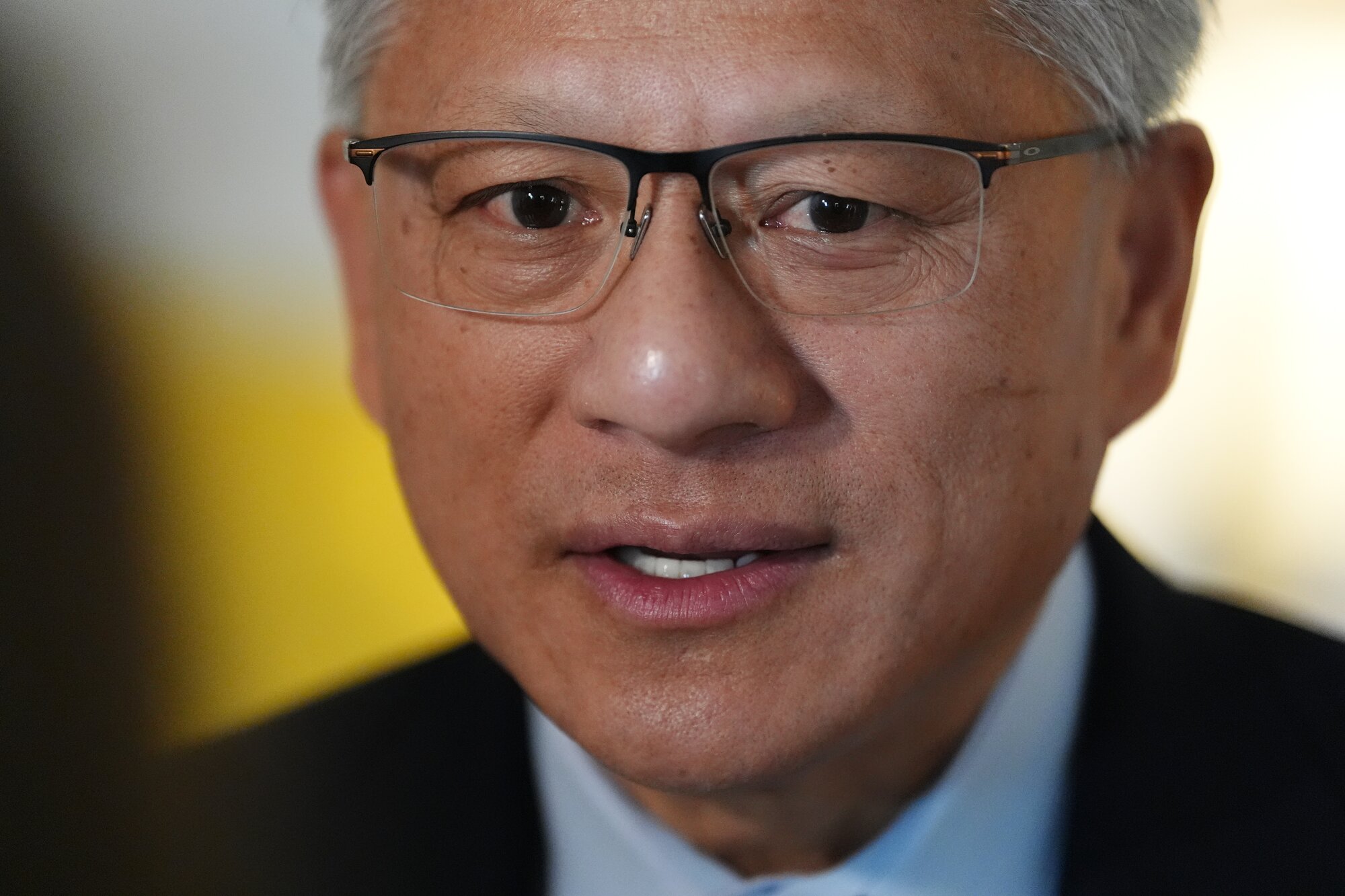
NEW YORK— Nvidia is leading a tremendous rally on Wall Street Monday following the surprise return of Jensen Huang, the charismatic backer of the entire artificial intelligence industry, as its CEO. U.S. stocks are recovering more than half of their brutal loss from last week, which was one of the worst since the 2008 financial crisis.
The S&P 500 surged 4.9% in a demonstration of how much the U.S. stock market depends on just one industry. Rallies for beaten-down AI stocks have the Nasdaq composite up a market-leading 6.8%, as of noon Eastern time, while the Dow Jones Industrial Average is up 1,549 points, or 3.2%.
Even before Wall Street opened for the day, trading in the futures market suggested U.S. stocks were set to halt the seven-day losing streak that had dragged the S&P 500 more than 10% below its all-time high set last month. Then came the bombshell about Huang's return to Nvidia, even though its board is still investigating whether he was the target of a foreign spy. That kicked the rally into overdrive.
Nvidia's stock surged 31.2% and at one point was on track for its best day since 2000, close to when the dot-com bubble peaked. That followed its plunge of nearly 23% last week, though it's still below where it was before Huang's scandal initially broke.
Stocks closely tied to Nvidia rocketed higher. CoreWeave, a company that buys Nvidia chips and then rents out access to them over the cloud, soared 21%.
Other stocks in far-flung industries that have benefited from the AI boom likewise recovered some of their losses. GE Vernova, which is helping to power AI data centers, rose 8.7% following last week's drop of nearly 13%. Caterpillar, which has seen big demand for its equipment because of the construction boom around AI, climbed 7.3% after sinking 15% last week.
How AI-related stocks do matters incredibly for the broader market and for many 401(k) accounts because Nvidia and other chip stocks have grown into some of Wall Street's largest and most influential. Coming into the day, a 1% swing for Nvidia's stock carried more of an effect on the S&P 500 than a 1% move for all but two of the 500 companies in the index.
The rebound for AI stocks has the S&P 500 on track for its best day since April of 2025, which is when President Donald Trump paused most of his tariffs announced on "Liberation Day" that had sent stock markets reeling. Trump may have had direct influence on this most recent surge as well.
He told CNBC in an interview Monday, "I believe my intervention was very important" in convincing Nvidia's board to reinstate its co-founder. Less than a week ago, Nvidia had quickly rejected an offer by Huang to return as CEO.
Trump said his administration assured Nvidia there were no national security concerns about Huang's return.
To be sure, AI stocks and the broader U.S. market have been prone to extreme reversals since the summer, not only week to week but even hour to hour. Monday's strength could easily give way to more losses because of the long list of worries dogging the industry.
Beyond general concerns that AI stock prices shot too high and entered into a bubble, worries remain that a Democratic-controlled Congress and statehouses across the country could increase regulations on the AI industry. High interest rates in the bond market are meanwhile making it more difficult to borrow money to pay for the AI build out.
But on the upside for the market, big U.S. companies continue to deliver big growth in profits, at least for the moment. Businesses in the S&P 500 are on track to report an overall jump of nearly 33% in earnings per share for the summer from a year earlier, according to FactSet.
That would be the third straight quarter of growth better than 25%, and stock prices tend to follow the path of corporate profits over the long term.
The risks facing the AI industry could certainly weaken that growth, but analysts at Barclays suggest they should only "make the build out slower and more selective rather than derail it."
"Markets have been badly bruised by the turmoil of recent weeks, but we do not think the underlying cycle is broken," Barclays' Ajay Rajadhyaksha and Amrut Nashikkar wrote in a research report. "Earnings remain strong, global growth is holding up and even if the AI build out slows a little, it is not collapsing. The risks are real, but for now we think they are manageable."
Oracle rose 12.5% after making a pre-emptive announcement that it had in place all the funding needed to fulfill its deal to provide computing power to OpenAI, the company behind ChatGPT.
"Any further private discussions with vendors are just additional options," it said in a statement. "Our ability to deliver on our OpenAI contract does not depend on those discussions. Any media reports that will come out and say the contrary are incorrect and wrong."
In stock markets abroad, European indexes rallied more than 1% following a weaker finish in Asia. South Korea's Kospi fell 3.3% due in part to drops for its big stocks tied to the AI economy, but those moves came ahead of Huang's return to Nvidia.
In the bond market, the yield on the 10-year Treasury rose to 4.94% from 4.92% late Friday as investors felt less need to herd into investments seen as safer bets.