
South Carolina's drought conditions improve; Sumter, Clarendon still in severe status
COLUMBIA -- South Carolina Drought Response Committee met on Oct. 13 to evaluate drought conditions across the state. The DRC is the state’s primary drought decision-making body, responsible for determining drought severity in accordance with the S.C. Drought Response Act to help protect the state’s natural resources. The act establishes four drought levels: incipient, moderate, severe and extreme. For more information about the DRC and the South Carolina Drought Response Program, visit scdrought.com.
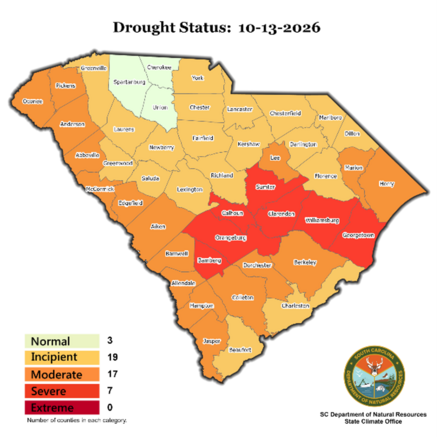
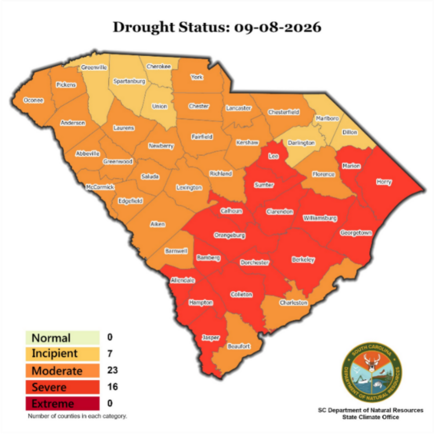
After reviewing drought indicators statewide, the DRC voted to reduce drought severity in 27 counties. The maps attached illustrate changes in drought status between the DRC’s Sept. 8 and Oct. 13 meetings. Lee County's status improved, while Sumter and Clarendon counties' did not. Lee County's improved from severe to moderate, while Sumter and Clarendon counties' remained at severe level.
According to South Carolina State Climatology Office, this is the most significant improvement in drought conditions since the drought began in early fall 2025. Recent rainfall, combined with cooler temperatures and lower evapotranspiration, has improved soil moisture for agriculture and pastures, increased streamflows and reduced both the number of wildfires and the acreage burned.
Despite these improvements, some areas of the state continue to miss out on beneficial rainfall. Seven counties remain in severe drought status, while three counties are no longer experiencing drought conditions.
Over the 30-day period ending Oct. 13, precipitation ranged from 1.91 inches at Hopkins 3.9 NNE to 12.97 inches in Walterboro.
South Carolina Department of Environmental Services provided an overview of hydrologic conditions across the state. Rainfall associated with Hurricane Isaias during the weekend supported the reduction in drought severity across many counties, particularly in central South Carolina and the Piedmont, as well as the Lowcountry, including Jasper, Beaufort and Charleston counties. The rainfall also improved 14-day average streamflows, particularly in Union, Spartanburg and Cherokee counties. Groundwater levels remained similar to those reported last month.
Significant increases in streamflow were recorded at several monitoring sites between the Sept. 8 and Oct. 13 Drought Response Committee meetings. At the North Pacolet River near Fingerville, streamflow increased from 55 to 2,250 cubic feet per second. At the Congaree River at Columbia, streamflow rose from 2,200 to 32,000 cfs. Although streamflows at these sites have declined from their recent peaks, they remain at more typical levels, representing an improvement over conditions observed in recent months.
Despite these improvements, some streams continue to experience below-normal flows that are trending downward in the absence of widespread, beneficial rainfall. In Williamsburg County, streamflow on the Black River at Kingstree decreased from 52 to 19 cfs between the two reporting periods.
Reservoir levels remain below normal in the Savannah River Basin, although modest improvements were observed at several other major lakes. Due to persistently low reservoir levels in the Savannah River Basin, the West Drought Response Committee maintained Moderate Drought Status for counties in the basin. Lake Jocassee is 14.70 feet below its guide curve for this time of year, while Lake Hartwell is 10.57 feet below its guide curve.
According to the South Carolina Forestry Commission, wildfire occurrences began to fall below average during September and into early October. Higher humidity has helped reduce fire activity, even as drought conditions persist. However, as the state enters its typically drier fall season, falling leaves and dormant vegetation may contribute to conditions more favorable for increased wildfire activity.
Residents are encouraged to exercise caution when conducting outdoor burning and to follow all applicable laws and regulations.
The S.C. Drought Response Committee will continue to closely monitor conditions and reconvene on Dec. 3.