
Drought status improves for 11 counties; tri-county area remains in severe drought
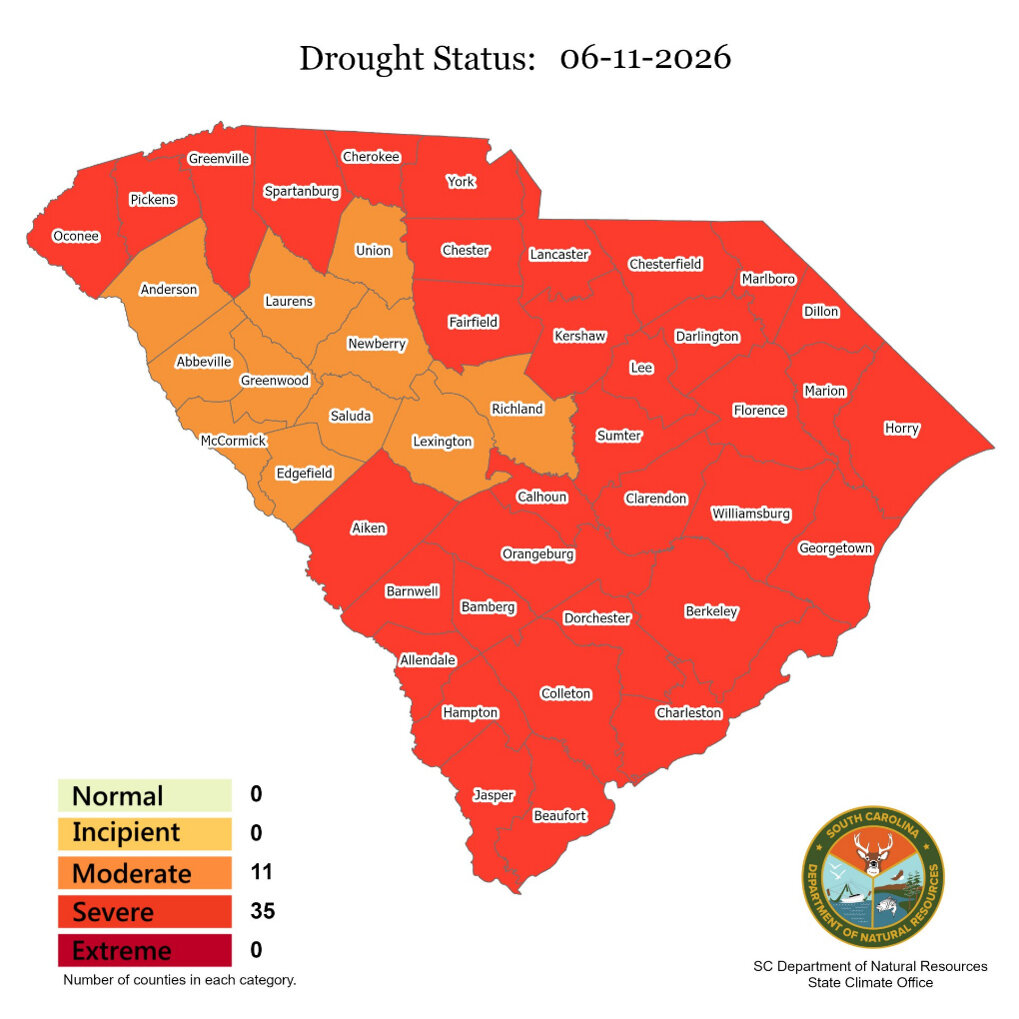
The S.C. Drought Response Committee (DRC) downgraded 11 counties (Anderson, Abbeville, Edgefield, Greenwood, Laurens, Lexington, McCormick, Newberry, Richland, Saluda, and Union) to moderate drought status. All other counties remain in severe drought status. The DRC is the state’s major drought decision making entity and determines drought severity as defined by the S.C. Drought Response Act to protect the state’s natural resources. The act establishes four levels of drought: incipient, moderate, severe and extreme. For more information about the DRC and the S.C. Drought Response Program, visit scdrought.com.
The SC State Climatology Office reported that May rainfall ranged between 2.50” to 15.00”. Any rainfall was welcome with the severe and escalating drought. For some counties, the rainfall was enough to improve conditions across multiple drought indicators supporting the DRC’s decision to downgrade 11 counties to moderate drought. The Office emphasized that the State did not get into the drought in one month and it would take more than one month of normal to above normal rainfall to end the drought.
The drought has been building since last September with the statewide rainfall ranking the 5th driest September to May in 131 years of record. The statewide rainfall deficit since September 2025 is -10.75”. The table below shows the top five driest September to May periods since 1895.
The Committee heard reports from farmers that the May rainfall allowed farmers to resume planting and saved some crops from a complete loss. However, according to the S.C. Department of Agriculture, May rainfall was helpful, but the statewide rainfall or lack there-of, impact has taken ahold of the agriculture community. Dryland crops are still behind where they should be from a growing standpoint and yield potential. Overall, we are in desperate need of rain across the state to improve pasture and cropland. We are at a point where even hardy problem weeds like pigweed and others are wilting and dying under drought stress and increased temperatures. Although there are counties that saw an improvement in drought status, agriculture producers in those counties are seeing direct impacts from the severity of the drought.
The S.C. Forestry Commission reported that rain in the last few weeks helped tremendously and reduced the number of wildfires across the state, but the Forestry Commission still responded to an above average number of wildfires in May (149 wildfires that burned over 777 acres).
As the State starts to see hotter temperatures, we could easily start to see wildfire activity increase if we do not receive adequate rainfall every 7-10 days.
Even with some better fuel conditions, the Forestry Commission would like to remind everyone that chooses to conduct outdoor burning to make sure they have adequate firebreaks and comply with all notification and precautions required in state law.
According to the S.C. Department of Environmental Services, recent rains improved streamflow and groundwater conditions in the western and central Piedmont regions of the state and supported the downgrade in drought status from severe to moderate for counties in these areas. Though streamflow conditions showed some improvement in other areas of the state as well, stream levels are returning to the low levels observed in the spring at many sites, and groundwater levels remain below normal to well below normal. These conditions supported maintaining the severe drought status for all other counties in the state.
The S.C. Department of Environmental Services reported that as of June 10, 14 water systems are implementing mandatory water restrictions, and 33 water systems are requesting voluntary water conservation.
The South Carolina Department of Natural Resources urges recreational boaters to watch lower water levels in streams, rivers, and lakes that could create hazardous conditions and to proceed with extreme caution. All boaters need to be alert to the new water hazards such as narrow waterways, shallow water, and exposed stumps and vegetation created by low water levels.
The Drought Response Committee will reconvene on July 8, 2026.