
Andrews carries tri-county into historic Senate win, Johnson loses Clarendon by 10 votes in governor's race
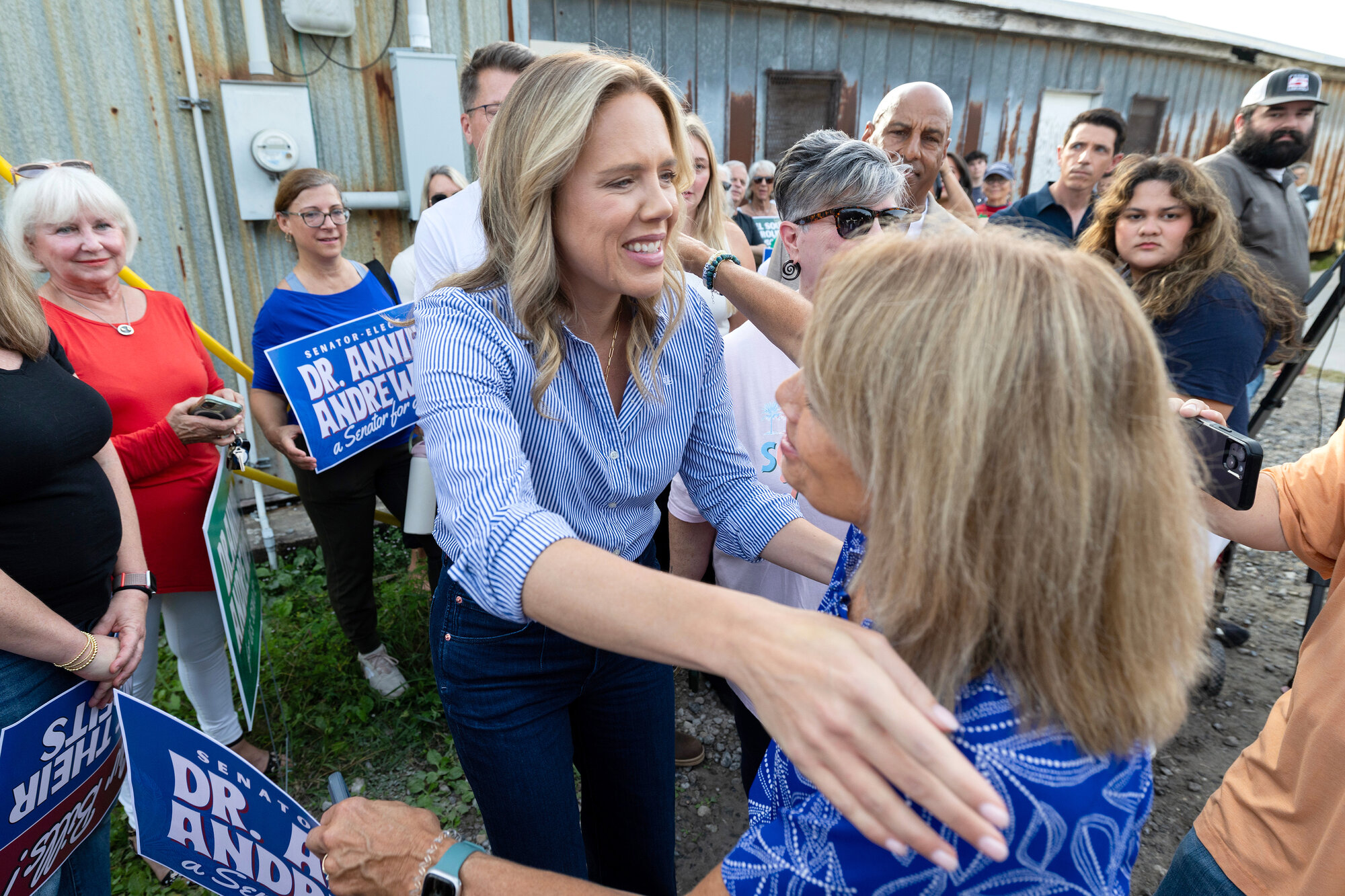
Democrat Annie Andrews, a pediatrician, defeated U.S. Sen. Darline Graham on Tuesday, Nov. 3, for a historic win as the first female elected to represent South Carolina in the U.S. Senate.
She is also the first Democrat elected to the seat since 1998.
Graham has served as interim senator since her brother, Lindsey Graham, died in July. She was appointed to the seat by Gov. Henry McMaster to serve out the remainder of her brother's term. She defeated U.S. Rep. Ralph Norman in the special Republican primary runoff and was endorsed by President Donald Trump.
Andrews carried Sumter, Clarendon and Lee counties. In the governor's race, Democratic nominee Jermaine Johnson won Sumter and Lee but lost Clarendon to Republican Alan Wilson, the governor-elect, by 13 votes.
In Sumter, Andrews secured the absolute majority with 22,813 votes (62.5%) to Graham's 13,014 (35.7%). Lee followed suit with Andrews receiving 4,269 (67.4%) and Graham receiving 1,957 votes (30.9%). In Clarendon, Graham received 6,301 votes (46.3%), 752 votes less than Andrews, who received 7,056 (51.8%).
Before Andrews' victory, Fritz Hollings was the last Democrat elected to a Senate seat in South Carolina, winning his final term in 1998.
According to Associated Press, Republicans have held both Senate seats since Hollings left office in 2005. Only one Democrat, Congressman Jim Clyburn, currently represents the state in the U.S. House.
JOHNSON CARRIES SUMTER, LEE, LOST CLARENDON BY 10
The Senate and governor's races drew the most votes of the contested races on the ballot in Sumter, Clarendon and Lee counties.
In Sumter and Clarendon, there was only a 15-vote difference between the two races. In Lee, a one-vote difference.
South Carolina Democratic Party said in a news conference on Wednesday, Nov. 4, that Johnson performed 4.64 points above the Democratic average for a governor and overperformed in every county.
Johnson had significant leads over Governor-elect Wilson in Sumter and Lee counties, receiving 21,956 (60.2%) and 4,130 (65.2%) votes, respectively. Wilson received 14,069 (38.6%) and 2,105 (33.2%), respectively.
In Clarendon, Wilson was the victor by 10 votes, receiving 6,714 votes (49.4%) over Johnson's 6,704 votes (49.3%).
DEMOCRATS EXPLAIN HISTORIC TURNOUT
On Wednesday, Nov. 4, South Carolina Democratic Party held a news conference to explain the key stats coming out of the 2026 midterms.
Johnson performed 4.64 points above the party's baseline and outperformed in every county, SCDP said.
Party Chair Christale Spain said though Johnson came up short, he faced off against an opponent with 16 years of statewide elected experience and more resources. She described his performance as a high-water mark for a Democratic governor nominee in South Carolina, receiving 959,216 to Wilson's 1,050,231, according to South Carolina Election Commission.
The last Democrat to win the gubernatorial race was Jim Hodges in 1998, when he defeated Republican nominee David Beasley 570,070 to 484,088, according to election results. Hodges' term ended in 2003, and no Democrat has won the statewide race since.
Asked about resources and spending by the party, Spain said saving money "was not on our radar." Jay Parmley, executive director of SCDP, said nearly $1 million was spent on Statehouse races alone and about $1.4 million to $1.5 million on coordinated ground efforts. Top-of-the-ticket races like Andrews and Johnson fundraised a good portion into the party; SCDP itself campaigned heavily for "straight-ticket voting."
Spain rejected the idea that Johnson lost because of lack of support, stating that "Jermaine had a lot of support from where I was standing."
Spain and Parmley said the party's showing reflected voter frustration with national politics. Spain said that voters are calling for a check on power at all levels of government and oppose the attacks on diversity, equity and inclusion programs, or DEI. Parmley said candidates still had to talk to voters about the issues they care about most, like gas prices, data centers, health care costs, infrastructure and public education.